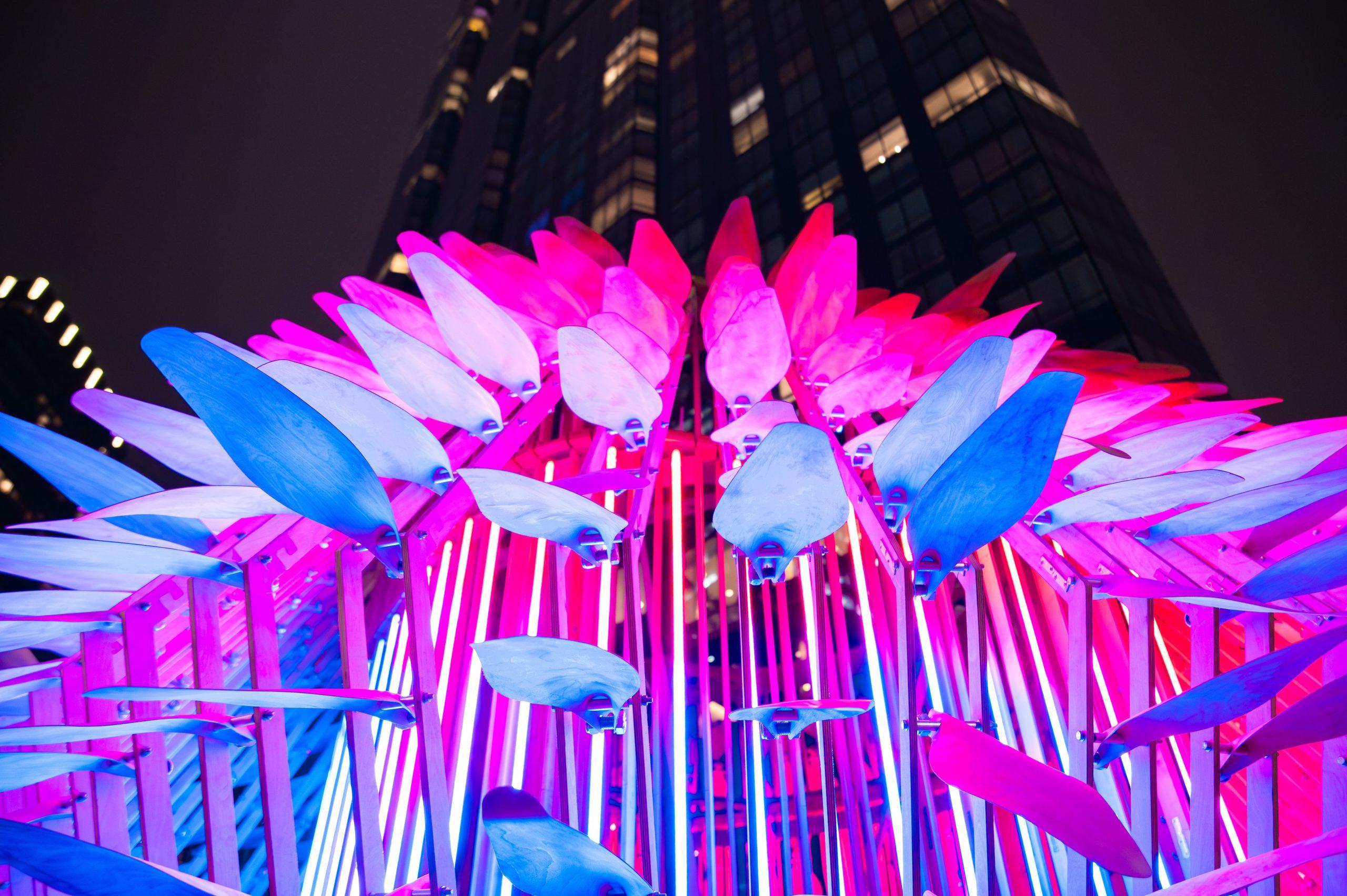
Since its creation in Montréal, moonGARDEN has transformed public spaces into luminous landscapes where light, movement and imagination come together. Presented at more than 50 events across North America, Europe and the Middle East, the LUCION installation continues to evolve with the places and communities that welcome it. In this interview, Bernard Duguay, Lucion’s founder, producer and designer, reflects on the origins of moonGARDEN, its relationship with public space, and the encounters that have helped shape the work over the years.
What inspired the creation of moonGARDEN, and how did the idea of transforming public spaces through light come about?
The idea was born during a competition for Lumothérapie in Montréal. We were looking for a way to safely bring artworks into public spaces. A way to experience art right in the heart of downtown. The giganticspheres offered an unusual form in which to frame an artistic experience. They also brought to mind the “set theory” we learned about at school, which explores the idea of families. In short, this installation offeredprotected screens and urban spaces dedicated to all kinds of artistic interventions.
The installation creates a dreamlike universe through colour, movement and shadow play.
What kind of experience do you hope to offer visitors?
The shadow play is inspired by the great master sculptor Christian Boltanski, who passed away in 2021. It evokes the Ogilvie shop windows that recreated small, deeply nostalgic villages. The idea of using the oldest art form in the world to create an innovative installation was very appealing. A lamp, an object, a movement and a metaphorical scene come to life. This principle of optics goes very far, and we pushed itquite a long way. We have even more ambitious visions for the near future.

moonGARDEN has been presented in many cities around the world. How does the work evolve depending on the places and communities that host it?
We are very privileged to be able to be on the ground with the public. By observing how people interact with the work, we become aware of their expectations, their disappointments and their surprises. It is the onlyway to improve the work. More and more, communities want to make the installation their own, with many children involved. They shape the content, the music and the light, using ways of working that are completely different from ours. We become hosts for local artists who are often better than we are.
At the heart of moonGARDEN is the idea of bringing people together.
What role can public art play in creating moments of connection?
moonGARDEN becomes a screen, an artistic space that can be created by local artists, citizens and children. The idea of telling the story of a particular place, illustrating it and, in a way, immortalizing it, creates a sense of belonging to our families, our ancestors and our territory. For me, that is the great discovery that moonGARDEN has brought about: the subject… is us.
What emotion, memory or sensation do you hope visitors take away after experiencing moonGARDEN?
There is something calming about this work. A somewhat “alien” atmosphere that brings people together without offering competitions, challenges or prizes, a moment of quiet observation without tension. Also, because of its size, the work somewhat dominates us, while remaining peaceful and rather extraordinary in itself. If someone leaves with the feeling that they, too, can create something beautiful with almostnothing, then we have achieved what we set out to do.

From city to city, moonGARDEN continues to evolve through its encounters with those who experience it. More than a light installation, the work becomes a space open to imagination, creativity and collective ownership. An invitation to slow down, see differently, and rediscover public space as a place where light can bring people together.