Created by NEON, an award-winning design practice based in the UK, founded by Mark Nixon and Viliina Koivisto, in collaboration with experiential light artist Frankie Boyle, The Living Lantern is a kinetic light installation that invites audiences to slow down and pay attention to their surroundings. Inspired by the universal symbolism of the lantern, the work brings together a sculptural structure in constant motion and a sensitive light experience that shifts with the wind, light, and context in which it is presented. In this cross-interview, Mark Nixon of NEON and Frankie Boyle reflect on the origins of their collaboration, their approaches to light and movement, and their shared desire to create experiences that foster contemplation, connection, and a deeper awareness of the world around us.
How did this collaboration come about, and what brought you together around the creation of The Living Lantern?
Mark Nixon: We (NEON) and Frankie were introduced by a mutual friend around the time of the Covid pandemic. We had a number of lovely online conversations where we discussed our respective practices and found that, while we worked in different territories — NEON between architecture and art, and Frankie with light — there were many overlaps in our ambitions, particularly around using art as a means of grounding the viewer in the present.
Around this time we were sent an open call for the Taiwan Lantern Festival, which was to be held in Hsinchu, and thought it could be a good opportunity to explore a collaboration with Frankie. The project was selected for the festival and The Living Lantern was born.
The lantern is a universal symbol of light, gathering, and renewal. What inspired you about this symbolism, and how did you seek to translate it into the artwork?
M. N.: As NEON primarily works in public space, many of our projects are designed so they can be immediately understood by the people who encounter them. We felt the lantern was an interesting motif because, at the time the project was conceived, the world was in the midst of a pandemic that restricted people from accessing and gathering in public spaces.
We were interested in this duality: the lantern as a symbol of hope in dark times, but also as a physical, illuminated object within a dark public space that could draw people together.
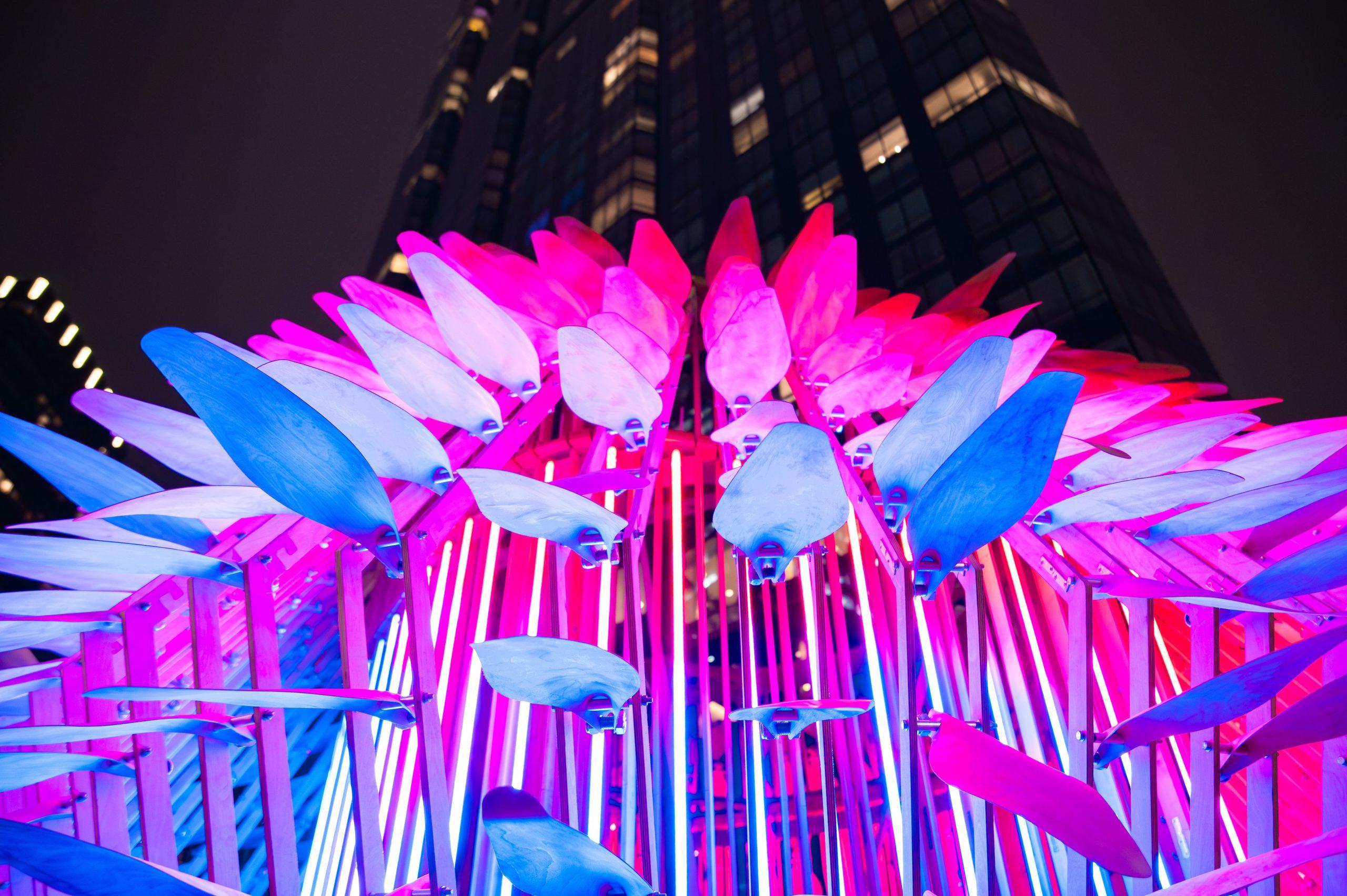
The Living Lantern also has a highly changeable, wind-responsive kinetic skin. We use movement in many of our projects as a way of encouraging a longer encounter — encouraging people not just to glance at an artwork, but to stay with it and watch it change.

Light is at the heart of the design. What inspired the choice of light, colour and movement?
Frankie Boyle: Light is the most influential force we have on this planet. Everyone is looking for it, drawn to it like a beacon, we gather around light the same way we gather around a bonfire. Part of why a bonfire fascinates us is that it never repeats the same pattern twice.
We wanted that same quality in the piece. A lantern dictated by the wind physically cannot do the same thing twice, so we built in that randomness, letting nature’s own organic movement drive it. Alongside that, we ran the content on a thirty minute cycle, deliberately, so no one would feel like the show had finished and it was time to move on. It was designed to be a place to sit, connect with each other, and stay as long as you needed.
Your practices both explore the relationship between art, space, and human experience. How did your respective approaches come together and enrich one another throughout the creative process?
M. N.: NEON was responsible for the sculptural form of the artwork and its kinetic membrane, while Frankie developed the lighting technology and animations housed within it. The movement of the skin continually changes how Frankie’s light is revealed, while the light in turn gives the kinetic surface a completely different presence after dark. The beautiful thing about collaboration is that two distinct perspectives and skillsets can create something greater than the sum of their parts. There was also a fantastic wider team who brought expertise in engineering, CNC fabrication, electrics and other areas necessary to make the work possible.
F. B.: Our practices overlap really beautifully. I am a big believer that the spaces we design ultimately design us, so we need architecture around us that echoes the forms we see in nature, forms that let us connect back to our nervous systems and to a sense of safety. For me, light is the strongest sense we have, it quite literally dictates how we feel and experience the world around us. Bring that together with the architectural elegance of NEON’s work, and I felt our two practices could synthesize beautifully.
The artwork seems to have an almost living presence, interacting with the wind, light, and surrounding movement. How did you envision this relationship between the installation and its environment?
M. N.: The artwork was very much conceived as an object that would respond to its surroundings rather than remain static within them. Its kinetic skin makes the movement of the wind visible, while the changing light and strong sculptural silhouette draw people towards it. Uniquely for an artwork focused on light, The Living Lantern also has a completely different character during the day. Without illumination, the warmth and texture of the plywood skin become much more apparent, while the wind continues to animate the surface. In this sense, the environment is continually changing the way the artwork is experienced.

The piece has travelled to very different settings. How has it responded to each?
F. B.: The artwork seems to have an almost living presence. It’s been fascinating watching it move through such different locations and surroundings, from an open forest in Athens to Times Square in New York. It quite literally reflects the energy of the space around it. In Athens, it moved naturally, like a tree caressed by wind. In Times Square, it caught the harsh alleyway winds disrupting the landscape, so the form it took was far more erratic, a direct reflection of the space it sat in.
NEON places collaboration and context at the core of its practice, while Frankie explores perception and emotions through light. How did these two dimensions shape the experience offered to the public?
M. N.: There are two distinct but interconnected layers to the project: the sculptural and kinetic form, and the light housed within it. Both change over time — the kinetic skin in response to the wind, and the light through a series of meditative animations designed by Frankie. What makes The Living Lantern particularly interesting is the constantly changing relationship between these two layers. As the skin opens and closes, different amounts of light are revealed and concealed. The two systems are never entirely synchronised, which means no two moments of viewing the artwork are quite the same.
Why is it important for you to create artworks that invite people to slow down, gather, and pay attention?
M.N.: This idea feels particularly important as we become increasingly reliant on screens and interfaces in our everyday lives. Becoming immersed in these technologies can separate us from the people and places immediately around us.
At NEON, we believe kinetic artworks can encourage us to actively look for a prolonged period of time. Through that simple act of looking, we might feel the breeze on our faces, notice it moving through the landscape around the artwork, and become more conscious of the physical world we are part of. In public space, that attention can also become collective — people stop, watch and experience something together.
F. B.: We live in such chaos today, such attention deficit, that we forget to listen to our own bodies, our heart rate, our breath, our connection to self. Without artworks that physically make you stop and take notice, how do you get people to connect with each other, never mind with themselves? These are the points that highlight what’s already obvious in the natural world, we just need something to make us pause and see it.
What would you like visitors to feel
or take away from their encounter?
F. B.: I would like visitors to have had a beautiful, deep conversation with the person they came with. I would like people to sit and connect with their own breath and heart rate. I would like them to have the space to dream and escape the world for a moment, and to really tune into the colour and movement of something so abstract.
M. N.: We hope people experience a moment of pause and become more aware of what is happening around them — the wind, the light, the landscape and the other people sharing the space.
If The Living Lantern can hold someone’s attention for a little longer than they expected, and leave them feeling more connected to the place and moment they are in, then it has done what we hoped it would do.

Through The Living Lantern, NEON and Frankie Boyle create an experience in constant motion, where architecture, light, and natural forces come together. Rather than offering a spectacle simply to be observed, the work creates a space to pause, look, and share a moment with others. From one setting to another, its form and light continue to transform, while its invitation remains the same: to slow down enough to notice what surrounds us and, in that suspended moment, perhaps reconnect with ourselves, with one another, and with the place we inhabit.