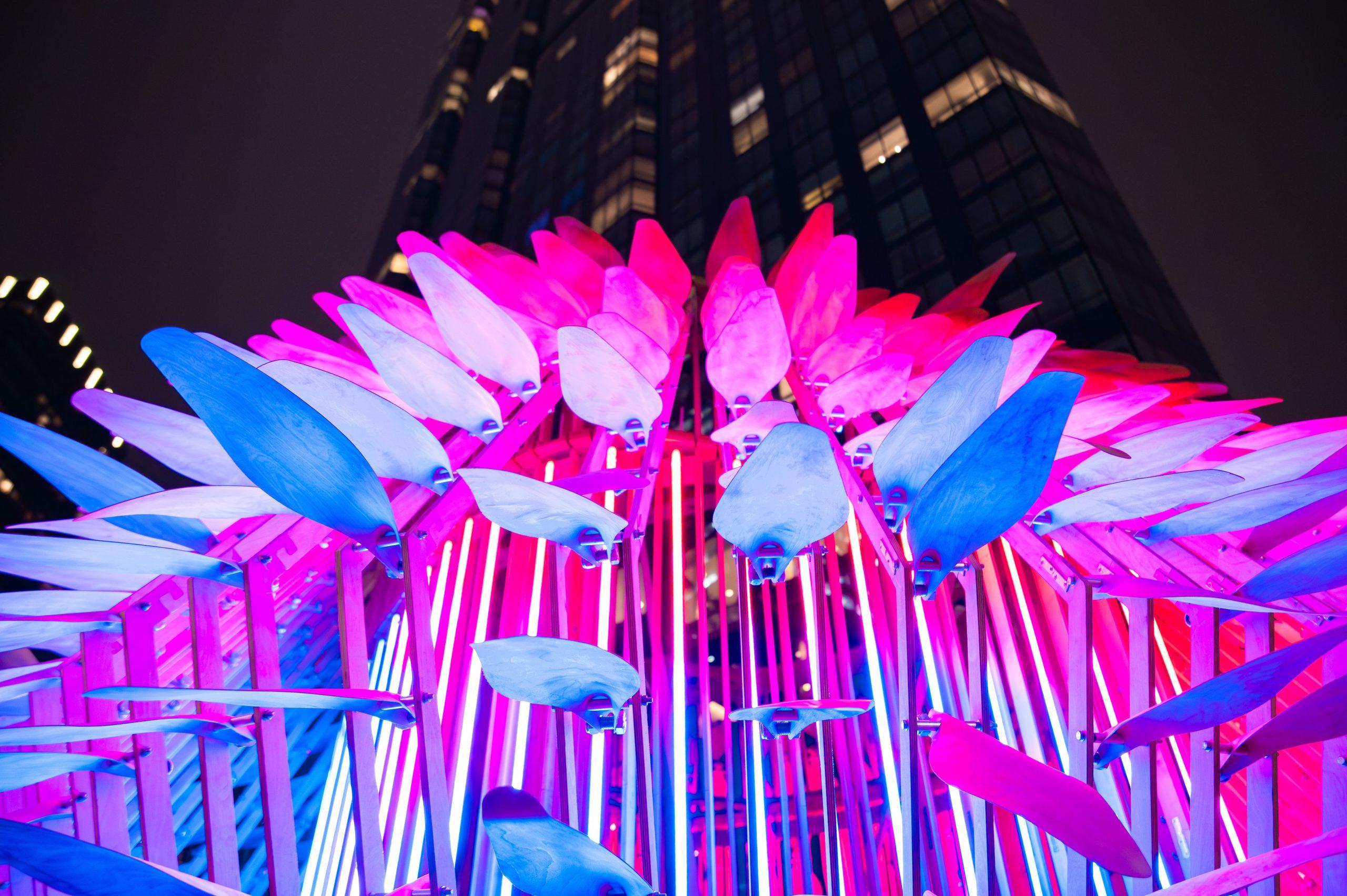
Designed and produced by Wireframe in collaboration with Audiotopie, who led the sound experience, Plenum explores the relationship between movement, sound, and public space. By transforming human gestures into light and sound, the installation invites visitors to actively participate in an artwork that is constantly evolving. The two teams share their creative process, collaborative approach, and the vision behind the project.
Interview with Alice Berthault, Curator and Producer, and Alex Stoicheff, Technical Direction Advisor and Architect at Wireframe, as well as Igor de Bagneux, Development Lead and Sound Designer at Audiotopie.
Plenum is the result of a collaboration between Wireframe and Audiotopie. When did the idea of working together first emerge?
Alice Berthault (Wireframe): Our desire to collaborate with Audiotopie began long before Plenum. Through our conversations over the years, we discovered a team that shared our vision of public art: creating accessible experiences that spark curiosity, encourage exploration, and invite people to reconnect with their surroundings. This alignment in our approaches made the collaboration feel completely natural.
What made you feel that your approaches were complementary?
Alice: We quickly realized that we shared the same intention, even though we approached it through different disciplines. What particularly resonated with us about Audiotopie was the way they use sound to transform our perception of space, extending far beyond the visual dimension. This closely aligned with our own vision at Wireframe, where we strive to create experiences that engage the body, movement, and the senses to reveal the full richness of public space.
Before becoming Plenum, what was the initial idea? Was there an intuition or a question you wanted to explore from the very beginning?
Alice: From the outset, we wanted to explore a question that is at the core of our practice at Wireframe: can an artwork encourage us to see our surroundings differently and feel more present in our own city? With Plenum, we set out to make the invisible forces and atmospheres that shape a place perceptible, inviting people to slow down, pay closer attention to their surroundings, and experience public space as a place of presence and connection.
Before Plenum, Audiotopie developed Osmose. Do you see Plenum as a continuation of that research, or as a new chapter?
Igor de Bagneux (Audiotopie): Nothing is ever lost; everything is transformed. Osmose is one of Audiotopie’s most ambitious works, both conceptually and formally. The creative process is, by nature, an ongoing experiment: we create, we learn, and we start again. Plenum is the result of Osmose, combined with Wireframe’s artistic and conceptual vision. Osmose is a polyphonic interactive artwork that elevates the sounds of nature while inviting audiences to reflect on their relationship with ecosystems. Plenum is both a continuation of this line of researchparticularly in the way the public’s gestures shape the sound, and a new chapter in terms of form and scale. Each collaborator brings their own background and expertise, allowing us to go further and push both the technical and artistic ambitions of the project.

How did this idea translate into the design of the space and the installation?
Alex Stoicheff (Wireframe): We built on the theremins developed by Audiotopie for the project Osmose and expanded that interaction into a fully spatial experience. We conceived the installation as an environment with blurred boundaries, where light, sound, and structure become materials that shape the perception of the space. The artwork continuously evolves through movement, interaction, and the presence of its visitors.
In Plenum, sound does more than simply accompany the light, it truly seems to shape the experience. How did you approach this relationship?
Igor: The analogy with cinema is probably the most compelling. A major shift occurred with the transition from silent films to “talkies” in the late 1920s: sound became a dramaturgical tool in its own right, activelyshaping the meaning of an image. Just as visual choices convey symbolism, emotion, and narrative, sound offers a wide range of possibilities to guide the audience’s attention and amplify the emotional impact. In public space, the site itself becomes an essential part of the listening experience. It transforms the way sound is perceived, creates a sense of surprise, and fosters an immersive experience that invites people to see and hear their surroundings in a new way.
Alex, how did your perspective as an architect influence the way visitors inhabit or rediscover the space through Plenum?
Alex: As an architect, I’m interested in how an artwork shapes not only a space itself, but also the relationship people develop with it. With Plenum, we worked with scale, rhythm, and repetition to create an environment that encourages movement, orientation, and a new way of experiencing a familiar place. Light, sound, and structure are not separate elements, but materials that evolve together to create an immersive environment where visitors are no longer simply observing the artwork, they become active participants in a collective experience that is constantly unfolding.

What kind of experience do you hope people will have when they step into the installation?
Alice: We hope to shift people’s attention to create a moment of curiosity and wonder that encourages them to slow down, observe their surroundings, and engage with the space in a different way. Through sound and interaction, Plenum remains an open-ended experience that transforms according to each person’s gestures, perceptions, and presence. Our intention is to create the conditions for everyone to make the experience their own.
With Plenum, were you also aiming to make people physically experience sound and space?
Igor: Absolutely. Two arches act as instruments, surrounded by three organs, each made up of five pipes that interact with them. Together, they envelop visitors in a halo of sound and light. As people move through the installation, their gestures influence how sound is projected through the surrounding pipes, creating an experience in which sound literally moves around them. Integrating space itself as a creative variable is a relatively recent development. Most people are used to seeing a band where each musician occupies a fixed position on stage, with the sound amplified through two or more loudspeakers. But what if the pianist suddenly teleported behind you? That’s the kind of spatial experience this new approach makes possible, and one we love exploring in public space.
Visitors create the music themselves through their movements. How do you compose a work that remains coherent while giving the public so much freedom?
Igor: The illusion of agency is perhaps our greatest ally. The idea is to frame the audience’s creative gestures by carefully constraining the variable parameters in a specific direction. That’s the path we continue to explore through Plenum. We programmed automations for sound effects, rhythmic patterns, and tonalities, while allowing visitors to trigger notes and effects. Each parameter can evolve over time, so the effectcontrolled by a sensor during the introduction may be different from the one heard at the climax. Finding the right balance between simplicity and effectiveness is a real challenge, but it creates an experience that is intuitive to grasp, offers a rewarding sense of progression, and remains engaging for everyonefrom musicians and gamers to the general public.
Today, we’re constantly surrounded by screens. Plenum offers a much more physical and collective form of interaction. Was that part of the intention from the beginning?
Igor: It’s a shared vision that lies at the heart of both Wireframe’s and Audiotopie’s identities. We deliberately avoid screens. That choice comes with its own constraints, but it also heightens the sense of surprise. Our goal is to inspire wonder and spark reflection beyond the pixel to reconnect people with their environment and create spaces for contemplation. Rejecting the screen isn’t just an aesthetic choice; it’s a way of shifting attention away from the digital stream and back to the physical world. In doing so, we remain true to our artistic direction: raising awareness about ecology through sound.
We’re fortunate to collaborate with partners like Wireframe, who share this vision throughout the project while bringing their own architectural, visual, and experiential signature.
How did the ideas evolve between Wireframe and Audiotopie throughout the creative process? Were some artistic decisions born from the dialogue between your respective areas of expertise?
Alice: When curious people come together around a shared intention, it opens up countless possibilities. The collaboration between Wireframe and Audiotopie was a true dialogue, with each team’s expertisehelping to shape and refine the project. Very quickly, much of our work became about clarifying what truly belonged to the artwork, often by removing rather than adding elements, to reveal the core of the experience and create a coherent, meaningful proposal for the public.
Igor, how has your collaboration with Wireframe influenced your own approach to sound? Are there ideas that might never have emerged without this dialogue?
Igor: First and foremost, it changed the scale at which we work. Designing sound for public space is inherently shaped by the scale of the site. Wireframe combines creative and technical expertise, and their extensive experience in public space as well as the diversity of the works they produce and present, gives them a perspective that few artists or studios of our size could anticipate on their own. They challenge us to ensure that our approach can adapt to larger environments, accommodate greater visitor density, and anticipate practical considerations such as transport and repairability. That’s where the dialogue between light, design, scenography, and sound becomes essential, and it’s the collaboration between Wireframe and Audiotopie that makes this possible.
Plenum aims to make invisible forces perceptible. What were the biggest challenges in achieving that?
Alice: One of the main challenges with Plenum was finding the right balance between the complexity of the concept and the simplicity of the audience’s experience. The deeper you go into a project and the more you develop your own language to describe it, the harder it becomes to see it with fresh eyes. That’s why testing with people who were not involved in the creative process is so important. It helps us understandhow the work is actually perceived and create a space where the artistic intention can meet an immediate, intuitive, and personal experience.
Beyond the installation itself, what kind of dialogue do you hope to create between the public, sound, and the space around them?
Igor : At its core, the dialogue we seek to open is one of listening itself. We live in spaces that we look at constantly, but rarely take the time to listen to. Plenum invites people to rediscover how to hear a place; to realize that the space around us is not neutral, that it responds, and that it transforms depending on whether we move, pause, play alone, or interact with others. At Audiotopie, our work can be summed up in one phrase: making places heard. What we hope is not simply that audiences leave having seen a beautiful installation, but that they leave with a more open eartoward public space in general, toward the city, and toward their own sonic environment. The true instrument is not the pipes or the arches themselves; it is the awareness and attention we manage to awaken.
If visitors were to leave Plenum with just one lasting feeling, what would you hope it would be?
Alice: If I had to choose one, it would be a sense of presence. Being fully aware of your body, your emotions, and your relationship with others. With Plenum, we hope to create a moment where visitors can slow down, pay attention to their surroundings, and feel truly present in the space, even if only for a brief moment.
Alex: For me, it would be joy. The kind of joy that comes from being immersed in an experience without overthinking it, and interacting with forces greater than ourselves while projecting our own imagination onto them. What I love about public space is its openness: everyone can experience the artwork in their own way, whether by creating a sound, watching the space respond to a gesture, or simply letting themselves becarried by the moment.

Plenum evokes an invisible space brought to life through human interaction. Do you think this project also reflects your vision of what cultural experiences in public space can become?
Alice: Absolutely. Plenum, like all of our projects at Wireframe, seeks to give people an active role in the way they experience their city. For us, a public artwork should first and foremost create opportunities for encounter, expression, and connection, allowing everyone to engage with the experience in their own way. What guides us is not only technological innovation or visual impact, but an artwork’s ability to evoke emotion, spark reflection, and bring people together around a shared moment. Plenum reflects this vision of cultural experiences that are more sensitive, participatory, and deeply human.
Igor: Yes, quite directly. For a long time, cultural experiences in public space have followed a stage-based model: there are those who create and those who watch. Plenum reverses that relationship. The spaceonly comes to life when the public takes action, and it reaches an entirely different scale when people engage together. The audience becomes a co-author. This is where we see the future of these experiences: less passive contemplation, and more physical and collective participation, in open and free spaces where people encounter the artwork rather than purchasea ticket to experience it. Sound is a particularly powerful medium for this because it surrounds us; it is not something we simply look at from the front; it is something we share. If Plenum succeeds, it is because it brings something into existence that belongs to no one person in particular and that is collectively created in the moment. For us, that is the direction we want to pursue.
—
The next chapter for Plenum is its encounter with the public. Discover the installation starting September 19. More details about its presentation will be announced soon.