Through her photographic self-portraits and poetry, Canadian artist Meryl McMaster, who has nêhiyaw (Plains Cree), Métis, British and Dutch ancestry, explores identity, ancestral histories, and our relationship with the land. In Fragile Harmonies, presented through Bloom’s structures, she brings these reflections into public spaces, inviting audiences to consider the delicate balance between people, place, and memory.
In your self-portraits, you create figures that seem to both emerge from and belong to the landscape. How do you build this relationship between your body, the sculptural costumes, and the places where you photograph them?
When I step out into the landscape and set up a photo, I’m trying to figure out how I fit into the world and how my history shapes who I am. My background is both nēhiyaw (Plains Cree), from Red Pheasant Cree Nation and member of Siksika Nation, and Euro-Canadian, so a lot of my work comes down to navigating those two worlds. I don’t really look at my self-portraits as being just about me. The characters I build and step into are more like storyteller figures. They let me cross between the past and the present, or between physical space and memory, seeing how the land holds onto all those stories. Making the wearable sculptures and garments by hand is a huge part of the journey. When I finally put them on and stand out in the elements, it can feel pretty exposed and open, but it also creates this quiet space to reflect on home, family, and where we all come from.
Your sculptural costumes are often made from natural materials. What does working with these materials allow you to express that other materials might not?
Working with natural materials, like feathers, branches, fur, soil or plant material, connects the artwork directly back to the land and the environment it came from. Those materials already carry their own history, memory, and presence long before I even touch them. Synthetic or manufactured materials don’t hold that same living connection or sense of time. When I gather or incorporate natural elements into my pieces, it allows me to build a physical link between my own body and the earth. It brings a sense of tactile honesty to the work, grounding the character in the landscape and acknowledging the living world as an active participant in the story rather than just a backdrop.

Can you tell us more about your creative process and how you approach your work?
My creative process is pretty slow and methodical, and it usually starts long before I ever press the shutter on the camera. It almost always begins with research and reflection, reading, exploring family histories, or thinking about specific stories and environments. From there, I start sketching out ideas and concepting the sculptural pieces or garments I want to create. Building those wearable elements by hand takes up a huge portion of my time, sometimes weeks or months, as I collect materials, craft the structures, and figure out how they will interact with the body. Once the sculpture and garments are ready, I scout out specific locations in nature that feel right for the story I’m trying to tell. The actual photoshoot is often the fastest part of the whole journey, but it’s also where everything comes together. Being out in the landscape, dealing with the elements, and stepping into the character brings the vision to life in a way that feels organic and complete.
The title Fragile Harmonies comes from your poem What Will I Say to the Sky and the Earth I & II. What does the idea of a “fragile harmony” mean to you today?
To me, “fragile harmony” speaks to the delicate, delicate balance that exists within us and around us. It is about how we relate to the environment, to time, and to our own personal and collective histories. Harmony isn’t a permanent, static state, it’s something that constantly needs care, listening, and attention to hold together. When we look at our relationship with the natural world today, or how we navigate complex identities and histories, that balance often feels vulnerable. Yet within that fragility, there is also incredible strength and resilience. It reminds us to tread lightly, stay connected to the land, and honor the intricate threads that keep us grounded.

A selection of your poems will be presented alongside the photographs in Fragile Harmonies. How do the poems and photographs speak to each other?
The poetry and photography really come from the same quiet place of reflection, but they express it in different ways. For me, writing poetry is another way to sketch out ideas and process emotions before or while an image comes to life. When they are shown together, the poems don’t serve as direct explanations or captions for the images. Instead, they act as companion voices. The photographs capture a specific frozen moment in the landscape, while the poems offer an inner narrative, expanding on the unseen thoughts, memories, and sensory feelings behind that moment. They create a conversation between what is seen and what is felt, giving viewers another doorway into the work.
The exhibition is presented through Bloom’s structures, which become part of the overall display. How do you see the dialogue between your photographs, these structures, and the spaces in which the exhibition can be presented?
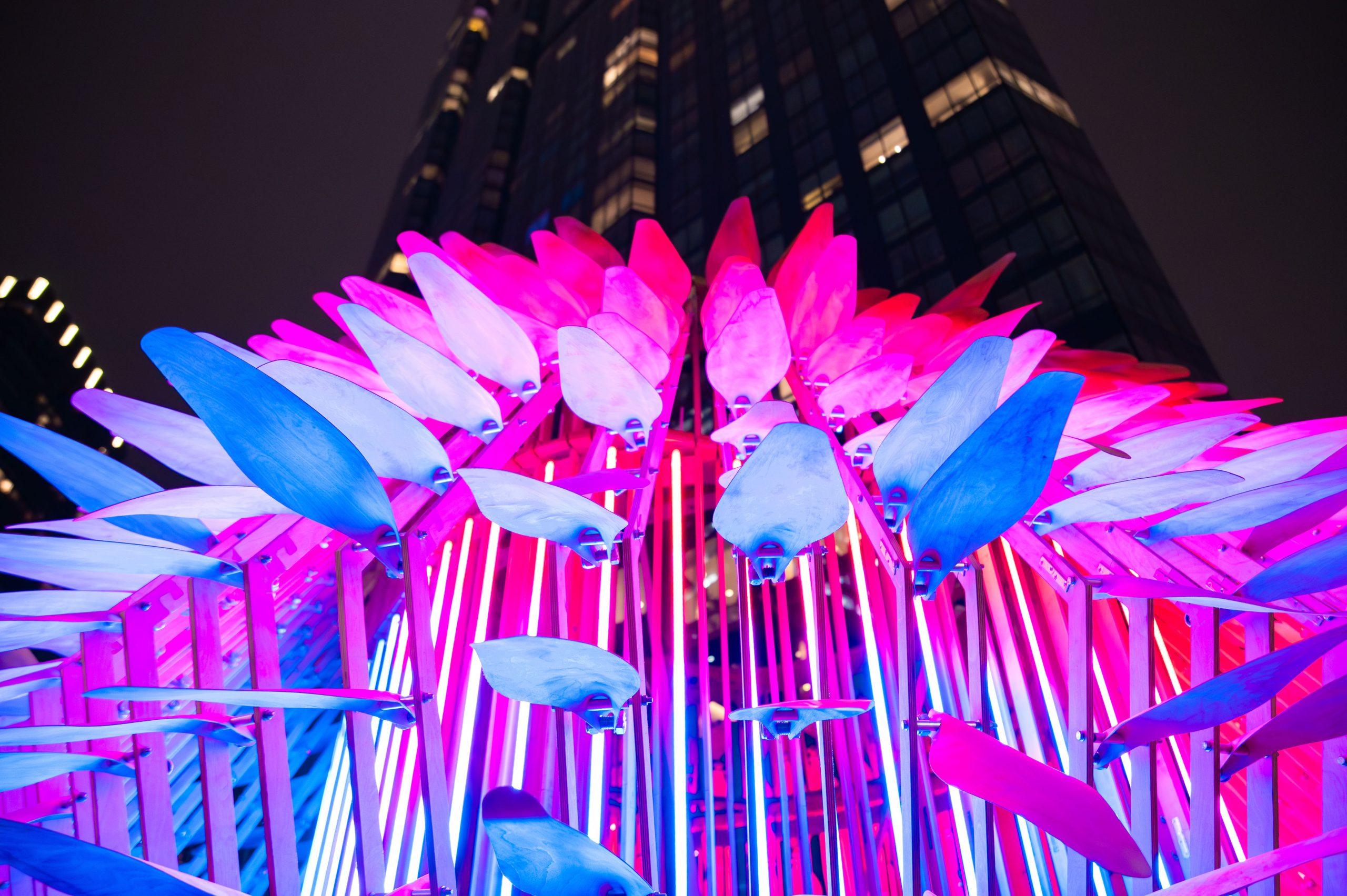
Placing the Bloom structures outdoors in public spaces transforms the dialogue entirely. It takes the work out of the traditional white-cube setting and roots it directly back into the living environment where the photographs were born. Rather than the images sitting flatly against traditional walls, these structures create an immersive environment in the open air where the viewer can move around, through, and between the works. It echoes the way I experience the natural landscape itself, where memory, space, and path-making are fluid and multi-dimensional. Outside, the dialogue becomes a shared atmosphere between the physical presence of the structures, the changing light and seasons, and the surrounding community. It invites people navigating their day-to-day lives to pause, step inside the experience, and reflect on their own relationship to place, history, and the natural world.

By bringing Fragile Harmonies into public spaces, the exhibition extends Meryl McMaster’s reflections beyond the frame, inviting audiences to pause and consider their own connections to the land and the histories it holds. Through Bloom’s structures, Wireframe creates new contexts for experiencing art beyond traditional exhibition spaces, making room for encounters that unfold within the rhythms of everyday life.